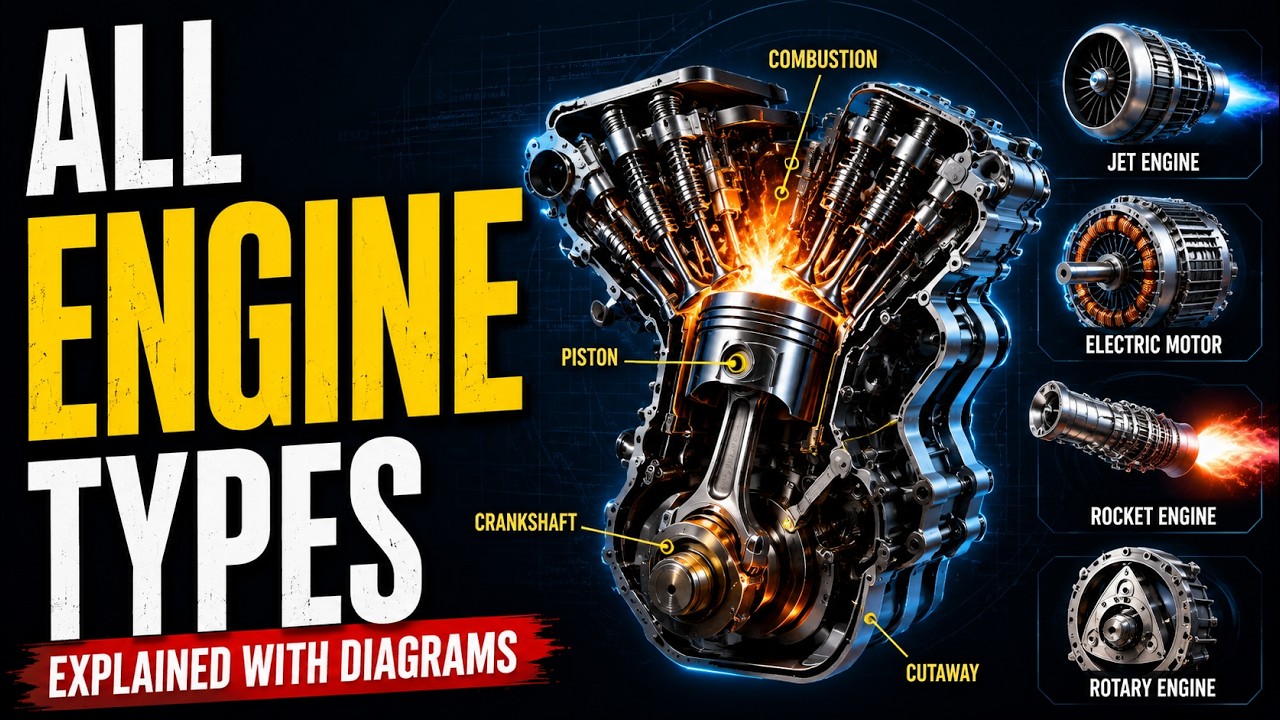
A jet engine generates thrust by accelerating a working fluid — almost always air mixed with combustion gases — rearward, pushing the aircraft forward by Newton's third law. The enormous diversity of jet propulsion systems, spanning turbojets, turbofans, ramjets, scramjets, pulsejets, and rotating detonation engines, exists because no single design is optimal across all speed regimes, altitudes, and mission profiles. Understanding how each engine type works reveals not just engineering ingenuity, but the fundamental physics of thrust, thermodynamics, and fluid mechanics that govern all aviation and aerospace propulsion.
Key Takeaways
- All air-breathing jet engines generate thrust by accelerating air rearward, but they differ radically in how they compress that air and sustain combustion.
- Turbofans dominate commercial aviation because their large bypass ratio dramatically improves fuel efficiency at subsonic and transonic speeds.
- Ramjets and scramjets have no moving parts, relying entirely on the vehicle's forward speed to compress incoming air — making them useless at rest but uniquely effective at high Mach numbers.
- Emerging technologies like rotating detonation engines aim to extract more work from combustion by exploiting detonation waves rather than deflagration, potentially offering significant efficiency gains.
The Turbojet: Where It All Began
The turbojet is the original jet engine, independently developed by Frank Whittle and Hans von Ohain in the late 1930s. It works through four stages: intake, compression, combustion, and exhaust — collectively known as the Brayton cycle. Incoming air is compressed by a series of rotating compressor stages, mixed with fuel in the combustion chamber, ignited, and then the hot, expanding gases spin a turbine before exiting at high velocity through a nozzle.
The turbine extracts just enough energy from the exhaust to power the compressor; the remaining kinetic energy provides thrust. Turbojets are mechanically elegant and perform well at high altitudes and supersonic speeds, which is why they powered early jet fighters and the iconic Concorde. Their major drawback is poor fuel efficiency at subsonic speeds — a limitation that led engineers to develop the turbofan.
Turbofans: The Engine That Conquered Commercial Aviation
A turbofan adds a large fan at the front of a turbojet core. This fan accelerates a significant volume of air around the outside of the core — the 'bypass stream' — rather than through it. The ratio of bypass air to core air is the bypass ratio, and it fundamentally determines the engine's character.
Low-Bypass Turbofans
Low-bypass turbofans (bypass ratios of roughly 0.2 to 1) are the engines of military fighters. They provide high specific thrust — lots of force per kilogram of air — and remain compact enough to fit inside a streamlined fuselage. Aircraft like the F-15, F-16, and Eurofighter Typhoon rely on low-bypass turbofans, often paired with afterburners for short bursts of extreme thrust. The bypass air still contributes meaningfully to efficiency compared to a pure turbojet, but the priority here is performance over economy.
High-Bypass Turbofans
High-bypass turbofans (bypass ratios of 5 to 12, and sometimes higher) are the workhorses of commercial aviation. Engines like the CFM56, GE90, and Rolls-Royce Trent series move enormous amounts of air, with the vast majority bypassing the core entirely. Because thrust is generated more by moving a large mass of air slowly than by moving a small mass very fast, high-bypass engines are dramatically more fuel-efficient and quieter. The penalty is size and weight — the fan diameter on a GE9X is over 3.4 meters.
Geared Turbofans
The geared turbofan (GTF), pioneered by Pratt and Whitney's PW1000G family, inserts a reduction gearbox between the fan and the low-pressure turbine. This allows the fan to spin at its aerodynamically optimal slower speed while the turbine spins faster for maximum efficiency. The result is a further 15–20 percent improvement in fuel burn over conventional high-bypass designs, along with significant noise reduction. Geared turbofans now power the Airbus A220, A320neo, and Embraer E2 families, and represent the current state of the art in commercial propulsion.
Turboprops and Turboshafts: Jet Cores Doing Different Jobs
A turboprop extracts nearly all the energy from the exhaust stream through an extended turbine and uses it to spin a conventional propeller via a gearbox. The exhaust itself contributes only a small fraction of total thrust. This makes turboprops exceptionally efficient at speeds below about 650 km/h, which is why they dominate regional aviation, maritime patrol, and agricultural aircraft. The Rolls-Royce Dart and Pratt and Whitney Canada PT6 are canonical examples.
A turboshaft is mechanically identical to a turboprop but delivers power to a shaft rather than a propeller. This makes it the engine of choice for helicopters — where the rotor system is driven by the shaft — as well as naval vessels, power generation turbines, and tanks. The turboshaft produces essentially no net thrust itself; all propulsive work is done by whatever the shaft is connected to.
Afterburners: Raw Thrust on Demand
An afterburner (or reheat system) is not a standalone engine type but an augmentation fitted to turbojets and low-bypass turbofans. After the turbine, the exhaust still contains significant unburned oxygen. An afterburner injects additional fuel into this hot exhaust stream and ignites it, producing a dramatic increase in thrust — typically 50 percent or more — at the cost of roughly doubling fuel consumption. Afterburners are used for combat maneuvering, supersonic dashes, and takeoff from short runways or aircraft carriers. The characteristic visible flame and roar of an afterburner are the result of combustion happening in the open exhaust duct.
Ramjets: Simplicity at Supersonic Speed
A ramjet dispenses with the compressor and turbine entirely. At speeds above roughly Mach 2, the forward motion of the aircraft compresses incoming air sufficiently through the geometry of the intake alone — a phenomenon called ram compression. Fuel is injected into this compressed air, combustion occurs, and hot gases exit the nozzle to produce thrust. With no rotating parts, ramjets are mechanically simple and capable of sustaining combustion at speeds where turbine blades would be destroyed by aerodynamic heating. However, a ramjet produces no thrust at rest or at low speeds, so it must be accelerated to its operating regime by another system — typically a rocket booster or a turbojet in a combined cycle engine.
Scramjets: Combustion at Hypersonic Speeds
A scramjet (supersonic combustion ramjet) extends the ramjet principle into the hypersonic regime — above Mach 5. The critical difference is that in a scramjet, the airflow through the combustion chamber remains supersonic. In a conventional ramjet, the intake slows the air to subsonic speeds before combustion; in a scramjet, slowing the air that much would generate catastrophic heat. Instead, fuel must mix and ignite in a supersonic airstream in milliseconds — one of the most difficult engineering challenges in aerospace.
NASA's X-43A demonstrated sustained scramjet combustion at Mach 9.6 in 2004, and the X-51A Waverider reached Mach 5.1 for over three minutes in 2013. Scramjets remain largely experimental, but they are central to hypersonic cruise missile programs and potential future access-to-space vehicles. Combined cycle engines that transition from turbojet to ramjet to scramjet mode — sometimes called turbine-based combined cycle (TBCC) engines — are one proposed path to reusable hypersonic flight.
Pulsejets and Pulse Detonation Engines
The pulsejet is historically significant as the engine that powered the German V-1 flying bomb of World War II. It operates by intermittently opening and closing intake valves, admitting air in pulses, igniting a fuel-air mixture, and allowing the pressure wave to exit through the nozzle. The cycle repeats dozens of times per second, creating the distinctive buzzing sound that gave the V-1 its nickname 'buzz bomb.' Pulsejets are mechanically simple but extremely loud, inefficient, and subject to high vibration.
Pulse detonation engines (PDEs) are a modern evolution of this concept. Instead of deflagration — the relatively gentle burning that occurs in conventional combustion chambers — PDEs use detonation waves that propagate supersonically through the fuel-air mixture. This thermodynamic cycle is theoretically more efficient than the Brayton cycle used in turbines, potentially improving specific impulse significantly. PDEs remain largely in the research phase, though they have been flight-tested in demonstrator aircraft.
Rotating Detonation Engines: The Next Frontier
Rotating detonation engines (RDEs) take the detonation concept and stabilize it as a continuous, spinning detonation wave that travels around an annular combustion chamber. Fuel and oxidizer are injected continuously, and a single detonation wave — or sometimes multiple waves — processes the mixture at supersonic speeds. This approach promises higher thermodynamic efficiency, a more compact engine, and the potential for both air-breathing and rocket variants. The U.S. Air Force Research Laboratory and multiple aerospace companies have demonstrated RDE operation, and the technology is viewed as a serious candidate for next-generation propulsion systems.
Rocket Engines: Carrying Their Own Oxidizer
Rocket engines are not air-breathing; they carry both fuel and oxidizer onboard. This makes them uniquely capable of operating in the vacuum of space but also extraordinarily demanding in terms of propellant consumption. Chemical rockets can be liquid-propellant (such as the RS-25 engines on the Space Shuttle, burning liquid hydrogen and liquid oxygen) or solid-propellant (like the Space Shuttle's solid rocket boosters). The specific impulse — a measure of fuel efficiency — of chemical rockets is lower than air-breathing engines at equivalent speeds, but no other technology can currently reach orbital velocities or operate beyond the atmosphere.
Choosing the Right Engine: A Question of Mission
The diversity of jet engine types reflects the diversity of flight itself. A commercial airliner cruising at Mach 0.85 at 35,000 feet needs maximum fuel efficiency; a high-bypass turbofan is unambiguously the right tool. A Mach 3 reconnaissance aircraft demands the sustained supersonic performance that only a low-bypass turbojet or afterburning turbofan can provide. A hypersonic cruise missile needs the simplicity and speed tolerance of a scramjet. An orbital launch vehicle needs a rocket. Each propulsion system is, in its own domain, an optimized solution to the relentless physical constraints of the Brayton cycle, thermodynamics, and the atmosphere itself.